Merge Magic!
- 4.3
- Rating
- 10.00M
- Installs
- Free
- Price

 Analysis by App-foxy
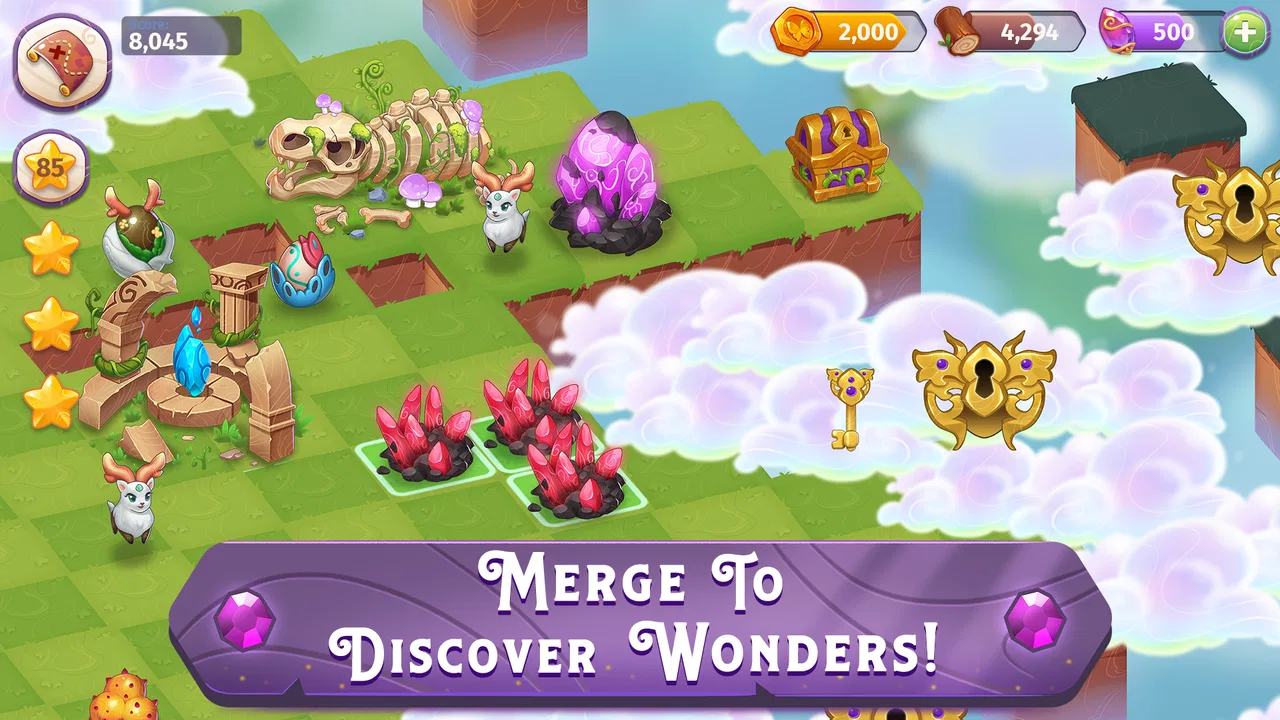
Merge Magic! is the kind of puzzle game I can open with no preparation and understand within seconds, yet it keeps enough small decisions in front of me to make a longer session feel worthwhile. I match objects, build up a magical landscape, and hatch creatures while working through a world affected by a curse. The basic idea is approachable, but the appeal comes from deciding what to combine now, what to leave untouched, and how to keep a crowded board from working against me.
My first impression was that the game wants to feel calm before it asks me to think hard. The presentation uses a bright fantasy setting, rounded creature designs, and a landscape that gradually becomes more interesting as I interact with it. That softness matters because the board can become surprisingly busy. The gentle visual language gives the action a readable frame instead of making every objective feel like a race.
As a free puzzle game from Gram Games Limited, it is easy to try without committing money at the start. It is rated for Everyone, and the current version is 10.5.0, with support beginning at Android 7.1. The game has reached over 10 million installs and holds a 4.3 average from around 207 thousand ratings, which fits my impression of a polished, widely accessible title rather than a niche experiment.
You May Also Like

 Blood Strike: 2.5 Anniversary
Blood Strike’s Loadouts Turn Every Drop Into a Tactical Gamble
A close look at Blood Strike’s custom loadouts: how fast access to signature weapons reshapes its battle royale rhythm, rewards preparation, and narrows the gap between fights.

 Pandora - Music & Podcasts
Pandora’s Music Is Easy to Start, but Harder to Recover
Pandora’s strength is its low-effort path from a seed to a station. Its weak spot is how much confidence it asks you to place in connection, setup, and quiet recovery.

 8 Ball Pool
 Is Built on Rivalries, Rematches, and Routine
A close look at the rivalries, rematches, shared routines, and unanswered safety questions that turn a quick pool match into a persistent mobile community.

 Samsung Music
’s Quiet Strength Is Playing What You Already Own
Its reach comes less from spectacle than from dependable access to a personal library. That simplicity is both the app’s strongest retention engine and its ceiling.

 AccuWeather: Weather Radar
AccuWeather Review: A Quick, Clear Forecast for Everyday Decisions
For everyday plans, the best forecast is the one you can understand quickly. AccuWeather makes rain timing, radar, and local conditions easy to act on, with a few trade-offs.

 Hill Climb Racing
Why Hill Climb Racing Still Turns Crashes Into One More Run
A tiny car, a bumpy hill and one more upgrade: Hill Climb Racing keeps resurfacing because its simple chaos makes every near-miss feel personal.
More From Our News Desk
View All News


How the magical presentation supports the puzzle
I find the fantasy presentation most effective when it helps me read the board and gives each combination a sense of purpose, rather than simply making the screen look charming. That distinction matters in a game where a tidy layout can save time and a crowded one can slow a short visit. Next, I’ll look at how the matching decisions fit that persistent, gradually changing landscape.
A setting that gives matching a reason
The fantasy setting does more than decorate the board. The curse gives the landscape a sense of damage and recovery, so combining objects feels connected to restoring a place rather than simply clearing colored pieces. That framing is useful because merge games can otherwise become a sequence of identical actions. Here, the creatures and magical objects provide a reason to care about the next upgrade.
I also like that the world is visually legible without being plain. Objects have enough personality to make their stages feel meaningful, while the landscape provides a larger sense of progress. When several items are waiting to be combined, I can usually identify the important groups quickly. That is especially helpful during short sessions, when I want to make a few useful moves rather than study the entire screen.
The creature design is one of the strongest parts of the mood. Hatching and matching mythical creatures gives the board a warmer identity than a purely abstract puzzle. It also changes how progress feels: I am not only producing a higher-level object, I am developing a collection of fantasy life that belongs in the setting. The game remains mechanical underneath, but the art gives those mechanics a little emotional lift.
Why the visual style works during longer sessions
The soft colors and playful shapes make the game comfortable to look at while I am repeating similar actions. That does not mean the board is always effortless to read. Once many objects accumulate, visual abundance can become a problem. The same inviting detail that makes the world pleasant can also make it harder to decide which items deserve space.
My practical advice is to treat the board as a workspace instead of a scrapbook. I try to keep related objects near one another and avoid scattering single pieces across open areas. This makes future combinations easier to spot and reduces the chance that I will spend a session dragging items around without a clear plan. The game rewards that kind of tidiness more than it first appears to.
A second useful habit is to pause before making an obvious merge. Combining three matching pieces may solve an immediate problem, but holding pieces together can sometimes preserve more options for the next move. I found that the best decisions are not always the largest visible combination. The board often becomes easier when I think one or two steps ahead rather than chasing every available match.
Sound that keeps the world gentle
The audio direction supports the same mood as the artwork. The experience feels designed for relaxed attention, with sound functioning as a soft confirmation of actions rather than trying to dominate them. That makes the game comfortable in ordinary situations: I can play during a quiet break, while waiting for an appointment, or at the end of the day when I want something more engaging than scrolling.
The rhythm is important because the game does not depend on rapid tapping. My attention moves between scanning the board, dragging an object, watching the result, and deciding what to do next. The sound and animation give those steps a pleasant cadence. A merge feels like a small event, but the game does not turn every action into an urgent interruption.
That pacing also explains why I would not choose it for someone looking for intense puzzle pressure. Players who prefer fast timers, sharp difficulty spikes, or constant competitive tension may find the atmosphere too mild. Merge Magic! is better at creating a steady flow than at producing adrenaline. Its strength is the feeling of gradually shaping a magical space.
The rhythm of a realistic daily session
Imagine having ten minutes before a train arrives. I can open the game, inspect the current board, make a few safe combinations, and stop without needing to remember a complicated control scheme. If I have more time later, I can return to the same world and make more deliberate decisions. That flexibility is one of the most convincing reasons to keep it installed.
Short sessions are not completely frictionless, though. If the board is crowded or I have several possible chains in front of me, ten minutes can disappear into rearranging pieces. I sometimes begin with a simple goal, such as creating room or preparing a group for a later merge, instead of trying to improve everything at once. This keeps a brief visit from turning into unfocused board maintenance.
Where the mechanics fit the presentation
The matching system and the fantasy presentation reinforce each other because both are built around transformation. A small object becomes something more valuable, a creature develops through combinations, and the landscape gradually feels more active. The visual promise and the mechanical action point in the same direction, which is why the game feels coherent rather than like a generic puzzle with a magical skin.
At the same time, the underlying loop is familiar. If I compare it with traditional match-three games, the main difference is the emphasis on arranging objects in a persistent space instead of simply clearing a fixed grid. Compared with more competitive puzzle games, this one gives me more room to plan and less reason to rush. Compared with purely decorative collection games, it asks me to make meaningful spatial choices rather than only tap through rewards.
That middle ground will suit some players more than others. I enjoy having a board I can organize, but a player who wants a clean level, a clear finish line, and an immediate reset may prefer a conventional stage-based puzzle. Merge Magic! asks me to live with the consequences of earlier placement. A poor arrangement can make the next few moves feel awkward, while a thoughtful layout creates its own momentum.
Three-piece choices and the value of restraint
One of the less obvious skills is learning when not to merge. A quick combination may free space, but it can also remove pieces that would have supported a stronger chain. I now look for clusters that can lead to several useful actions rather than treating every match as an automatic command. This is a small change in mindset, but it makes the board feel much more strategic.
I also separate immediate cleanup from long-term progress. If the screen is crowded, creating open space can be the correct move even when it does not produce the most impressive object. If the board is already organized, I can afford to wait and build a better group. This trade-off is where the game becomes more interesting than its simple controls suggest.
Managing attention instead of chasing every reward
The game is designed around ongoing progression, so it can encourage me to keep checking the board for another useful action. I recommend setting a stopping point before starting a longer session. For example, I might decide to prepare a particular group, clear a congested area, or finish one focused objective. Without that boundary, the gentle pacing can make the session feel longer than intended.
This is also where the free-to-play structure deserves honest attention. The game costs nothing to start, but optional in-app purchases range from $0.70 to $99.99 per item. I can enjoy the core loop without paying, yet players who are sensitive to purchase prompts or who dislike progression systems with optional spending should approach it carefully. I would not recommend buying anything simply because the board feels temporarily slow.
My preference is to treat purchases as entirely separate from the puzzle decisions. If I am enjoying the arrangement and creature-building itself, the game works as a relaxing hobby. If I feel that I need to spend in order to make the experience tolerable, that is a sign to close it for the day. The best version of this game, in my view, is the one played at a pace that remains comfortable without turning every delay into a reason to pay.
Who will enjoy the atmosphere most
I would recommend Merge Magic! to players who like gentle fantasy, collection, and puzzles that reward planning without demanding fast reactions. It is a particularly good fit for someone who enjoys watching a space develop over time and does not mind revisiting the same board with a new arrangement in mind. The Everyone age rating also makes its presentation broadly approachable, although younger players may still need guidance around optional purchases.
It is less suitable for someone who wants a tightly competitive challenge, a minimalist interface, or a game that can be completed in a few decisive rounds. It may also disappoint players who dislike managing a growing collection of objects. The board is part of the challenge, not merely a backdrop, and that means organization becomes a recurring responsibility.
Device age is worth considering too. The minimum operating system is Android 7.1, so the game is not limited to only the newest Android phones. Even so, the amount of visual activity can make a larger, clearer screen more comfortable for careful arranging. I find it easier to plan when I am not trying to distinguish several nearby objects on a very small display.
What keeps me coming back
The strongest long-term hook is not a single spectacular mechanic. It is the combination of a readable merge loop, a world that gives the loop context, and a pace that lets me choose how seriously I want to play. Some visits are about making a few safe improvements. Other visits invite more deliberate planning, especially when the board offers several possible chains.
The game also benefits from its sense of continuity. A conventional match-three title gives me a fresh arrangement and asks me to solve it. Here, my previous choices remain relevant. That creates a modest but satisfying ownership: the landscape is not just a level selected from a menu, it is a place I have been shaping through repeated decisions.
There is a trade-off in that continuity. A persistent board can feel more personal, but it can also feel less clean. When I return after a break, I may need a moment to understand what I was preparing and why certain objects are where they are. Leaving a small note to myself mentally—such as “keep this group together” or “make space on the left”—helps me resume without wasting the first few minutes.
My final take on the playable mood
After spending time with it, I see Merge Magic! as a puzzle game whose identity comes from the way its parts agree with one another. The art makes transformation feel charming, the mythical setting gives matching a purpose, and the sound and animation maintain a calm rhythm. None of that replaces the need to plan, but it makes planning feel inviting instead of clinical.
Its limitations are equally clear. The familiar merge foundation will not satisfy everyone, crowded boards can create friction, and the optional purchase range means some players will want to be disciplined about spending. The relaxed pacing can also feel too slow if I am in the mood for a demanding, tightly timed challenge. Those are important reasons to choose a different puzzle style when I want speed or a cleaner finish.
For me, the best use of this game is as a quiet, repeatable escape: something I can open for a short break, organize thoughtfully, and leave without pressure to master it immediately. If that sounds appealing, I think it is worth trying free. Its real strength is the harmony between atmosphere and action: every merge is simple, but the creatures, damaged landscape, and gentle rhythm make the small decisions feel like part of a larger magical recovery.
Merge Magic! is not a revolutionary puzzle system, and it does not need to be. Gram Games Limited has shaped a familiar idea into a world with a clear emotional tone and a comfortable pace. I would recommend it to anyone who wants a fantasy puzzle that values patience, spatial organization, and gradual progress more than reflexes or competition.
FAQs for Merge Magic!
01What is Merge Magic!?
Merge Magic! is a relaxing puzzle and adventure game in which you combine matching objects to create more advanced items. You explore enchanted gardens, complete level-based challenges, collect magical creatures, and restore areas affected by a mysterious curse. The basic gameplay is easy to understand, but later stages require careful planning because space, energy, and available moves can become limited.
02Is Merge Magic! free to download and play?
Yes, Merge Magic! can be downloaded and played for free on compatible Android and iOS devices. However, it includes optional in-app purchases, such as gems, bundles, and other resources that can speed up progress or provide additional advantages. You can enjoy the main game without paying, although waiting timers and limited resources may encourage purchases during longer play sessions.
03Does Merge Magic! require an internet connection?
Merge Magic! may allow some gameplay while offline, particularly for basic puzzle activities, but an internet connection is generally recommended. Online access can be needed for events, cloud-related features, advertisements, purchases, updates, and synchronizing progress. If you change devices or reinstall the game, connecting to the internet and using the available account features can help reduce the risk of losing your saved progress.
04Is Merge Magic! suitable for children?
Merge Magic! is generally easy for children to understand because it uses colorful graphics, simple touch controls, and non-violent fantasy gameplay. Nevertheless, parents should review the game’s in-app purchases and advertising options before allowing younger players to use it. Some progress systems and timers may also encourage repeated play, so parental controls and purchase restrictions are advisable.
05What are the main advantages and disadvantages of Merge Magic!?
The main strengths of Merge Magic! are its attractive fantasy presentation, satisfying merging mechanics, large collection of objects and creatures, and a good variety of goals to complete. It is accessible for casual players while still offering strategic decisions. On the other hand, progress can feel slow when resources or energy run out, and optional purchases, timers, advertisements, and event-based content may frustrate players who prefer a completely uninterrupted experience.
Pros
- Hundreds of levels provide plenty of content for long-term play.
- Offline play makes it convenient during travel or without a stable connection.
- Combining objects feels satisfying and gives clear visual progress.
- Regular events add fresh challenges and unique rewards.
- The calm fantasy setting makes it suitable for relaxed
- casual sessions.
Cons
- Energy limits can interrupt play when you want longer sessions.
- Some upgrades and progress can require considerable grinding.
- The board may become cluttered as more objects and creatures appear.
- Timed events can feel demanding for players who play infrequently.
- Optional purchases may tempt players seeking faster progress.

Merge Magic!
Gallery